
Union Health Secretary Punya Salila Srivastava highlighted the strong health cooperation within BRICS, emphasising the critical role of digital health and artificial intelligence in ensuring continuity of care. Speaking at the 16th BRICS Health Ministers' meeting, she noted shared challenges among member nations and showcased India's advancements in digital health infrastructure and AI strategy.

For India, the goal is not simply to host another grand diplomatic gathering. It is to prove that a diverse coalition of emerging powers can still deliver.

BRICS leaders, in their New Delhi Declaration 2026, have called for wider access to Artificial Intelligence resources and stronger international cooperation to ensure the technology is safe, secure, inclusive, and reliable. The declaration outlines a broad technology agenda covering AI, cybersecurity, digital public infrastructure, telecom, quantum technologies, and advanced manufacturing, committing to implement the grouping's statement on 'Global Governance of Artificial Intelligence'.

The highlight of the successful BRICS Summit was its ability to deliver a joint statement that all members, including Iran and the United Arab Emirates, embroiled in the war in West Asia, signed.

The BRICS New Delhi Declaration has endorsed India's proposals for a Working Group on Sports Technology and a Sports Goods Manufacturing Conclave, aiming to enhance cooperation and innovation among member nations in the sports sector.

Union Minister Mansukh Mandaviya inaugurated the BRICS Traditional and Indigenous Sports Demonstration Games 2026 in Ahmedabad, emphasising the role of traditional sports in reflecting cultural identity and fostering international cooperation. The one-day event, hosted by the Ministry of Youth Affairs and Sports, brought together delegations from BRICS and partner countries to showcase indigenous sporting practices like Mallakhamb, Yogasana, and Kalaripayattu from India, alongside Wushu from China and Sambo from Russia. Gujarat Deputy Chief Minister Harsh Sanghavi also highlighted India's rich sporting heritage and proposed initiatives for global promotion and preservation of traditional sports.

India's proposal to link BRICS payment systems, including central-bank digital currencies (CBDCs), was notably absent from the grouping's New Delhi Declaration, despite being a key agenda item for India's chairmanship. This omission leaves the 16-year effort for trade in local currencies without a settled payment architecture, with the declaration only 'acknowledging' the work of the BRICS Payment Task Force.

South African President Cyril Ramaphosa on Friday described BRICS as an important global forum, highlighting the grouping's growing demographic and economic weight and noting that its members account for around half of the world's population and 40 percent of global GDP.

Russian President Vladimir Putin has proposed a new investment platform, based on the New Development Bank (NDB), to fund projects in trade, infrastructure, logistics, and technology across BRICS nations, emphasising that the grouping's expanding economic cooperation is not 'against anyone' but aims to advance members' national interests.

BRICS finance ministers and central bank governors have called for increased representation of emerging-market and developing economies in the IMF and World Bank, while also criticising unilateral tariffs and trade measures, as the expanded bloc aims to bolster financial cooperation amidst global fragmentation.
Prime Minister Narendra Modi cautioned against the 'weaponisation' of technology and critical minerals at the BRICS summit, advocating for cooperation to foster shared prosperity. Concurrently, Chinese President Xi Jinping announced plans for an open-source AI ecosystem for BRICS nations, positioning Beijing as a key technology partner amid global AI competition.

Chinese President Xi Jinping called for global collaboration in artificial intelligence development, emphasising a "symphony of global collaboration" over a "solo performance" by any single nation. Speaking at the World Artificial Intelligence Conference in Shanghai, Xi highlighted the need for ethical AI governance, shared prosperity, and addressing challenges like the widening digital divide. He also announced China's commitment to support developing countries with 5,000 AI research projects and training programmes. The event also saw 29 countries sign an agreement to establish the World Artificial Intelligence Cooperation Organisation (WAICO) in Shanghai.

Xi brought in asymmetrical power play by stating that India should have 'strategic cognition' and 'strategic judgement made on the basis of the stage of development the two countries are at'. This is a very nuanced way of asserting China's coercive diplomatic posture and reflects Beijing's penchant to unleash border instability at will, restrict rare earth metal exports, exert pressure on India at global and regional orders, asserts China expert Srikanth Kondapalli.
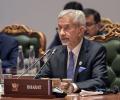
India has expressed serious concerns about the West Asia crisis and its potential impact on energy supplies and maritime stability, urging BRICS nations to find practical solutions to geopolitical challenges and unilateral sanctions.
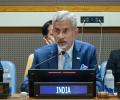
External Affairs Minister S Jaishankar has called on Brazil, Russia, India, China, South Africa (BRICS) to defend the multilateral trading system amid increasing protectionism and tariff volatility during a meeting of the bloc's foreign ministers in New York on the sidelines of the United Nations General Assembly session.

The BRICS nations have expressed concern over the proliferation of trade-restrictive actions in the form of 'indiscriminate rising' of tariffs, particularly measures used as a means of 'coercion', cautioning that such practices risk marginalising the Global South countries.

The formulations in the declaration in reference to terrorism is going to be to our "satisfaction", Dammu Ravi, secretary (economic relations) in the external affairs ministry said on Monday.
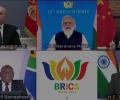
Asserting that it is for the first time that BRICS has taken a collective position on strengthening and reforming multilateral systems, Prime Minister Narendra Modi said, "We have to ensure that BRICS is more productive in the next 15 years".

Under the defence partnership, India and the UAE are eyeing defence industrial collaboration and cooperation in advanced technologies, cyberspace training, special operations, interoperability of their militaries and counter terrorism.

Prime Minister Narendra Modi visited Ethiopia on a bilateral visit, engaging with Ethiopian leadership to strengthen partnerships in various sectors. He was warmly welcomed by Prime Minister Abiy Ahmed Ali and participated in cultural events, highlighting the strong ties between the two nations.

Showing respect to the Indian flag, Prime Minister Narendra Modi on Wednesday immediately picked up the tricolour placed on stage at a BRICS meeting here to mark the standing place of every leader so as not to step on it.
Earlier, police froze Rs 8 crore linked to Saraswati and parked in multiple bank accounts and fixed deposits.

The meeting will be attended by Russian President Vladimir Putin, Chinese President Xi Jinping, South African President Cyril Ramaphosa and Brazil's Jair Bolsonaro, according to the MEA.
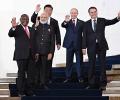
Chinese President Xi Jinping will attend the 13th BRICS summit to be held on Thursday at the invitation of Prime Minister Narendra Modi, China's foreign ministry announced in Beijing on Wednesday.
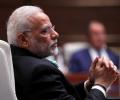
Modi said a separate rating agency would help the economies of the member countries as well as other developing nations.

So far the coronavirus, which originated in the Chinese city of Wuhan, has infected more than 54 million people around the world and killed over 1.3 million others.

Modi is also scheduled to hold a bilateral meeting with Xi on Tuesday.

Modi put forward new initiatives for the BRICS grouping

The PM said there was a need to tackle the problem of terrorism in an organised manner.

He said the Fourth Industrial Revolution will have more importance than the capital.

Noting that India has 'limitless possibilities and countless opportunities', Modi urged the BRICS business leaders to take advantage of them.
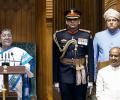
President Droupadi Murmu addressed both Houses of Parliament, highlighting the government's achievements in various sectors, including economic growth, social welfare, and infrastructure development. She emphasized the government's efforts to lift the economy out of "policy paralysis" and create a more inclusive society. Murmu also acknowledged the challenges posed by digital fraud and cybercrime and stressed the need for a social infrastructure revolution. The President's speech is considered a policy statement, outlining the government's vision and roadmap for the future.
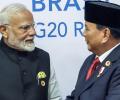
India is trying hard to erase Indonesia's wariness about New Delhi, building security cooperation in the Indian Ocean and Pacific Ocean. If Indonesia decides to buy the Brahmos missile, it would further strengthen relations between the world's most populous nation and the most populous Islamic country.

India was the second largest filer of international trademark applications among the BRICS nations in 2014.
'The group commands 85 per cent of the global GDP, and if you are able to convey your point of view effectively to this group then you have reached more or less all the important players that matter.'

External Affairs Minister S Jaishankar on Wednesday held wide-ranging talks with his Russian counterpart Sergey Lavrov focusing on the Ukraine conflict, bilateral ties and issues relating to the G20 foreign ministers' meeting.

'As part of our D33 strategy, the plan is to establish 30 unicorns in Dubai within the next 10 years.'

President Xi said that the Chinese side is ready to work with the Indian side to carry forward the fresh impetus of bilateral relations.

The time is ripe to extend the confrontation with the Chinese to the maritime domain, says former RA&W officer Krishan Varma.

'This novel format of diplomacy -- the informal summit -- will not only facilitate bilateral communication and reduce miscalculations at the very top level of the two governments, but possibly open the space for China and India to speak in one voice on various issues of mutual concern,' note Feng Renjie and Ding Kun Lei
